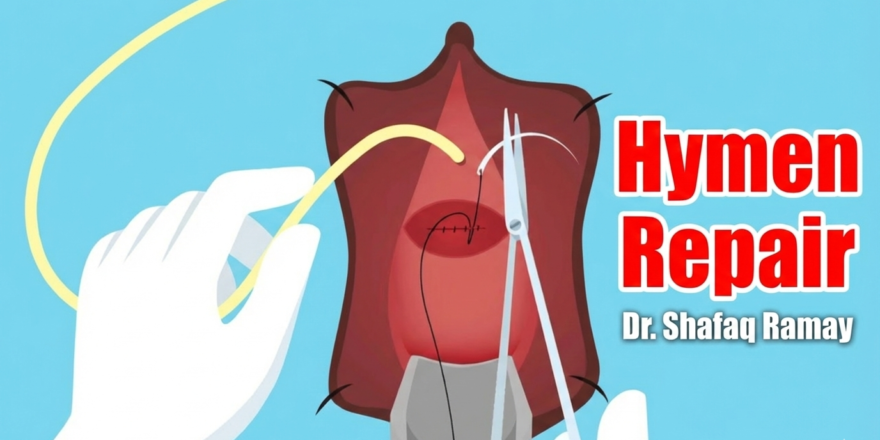

INTRODUCTION — The Hook
You’ve probably heard whispers about the “first night” — and maybe felt a knot in your stomach. Will it hurt? Will anyone know? What if things don’t go as planned? For many women in Pakistan, these questions stay locked in silence, wrapped in family expectations and cultural pressure.
You’re not alone, and it’s okay to want clarity without shame. Dr. Shafaq Ramay — a board‑certified aesthetic gynecologist at Lemonade Aesthetic Clinic — has helped hundreds of women navigate this exact decision with privacy and respect.
In this post, you’ll learn:
- What hymenoplasty actually is (and isn’t)
- How to tell if you’re physically and emotionally ready
- A clear comparison between expert hymenoplasty and pills
- How to choose what’s right for your life, your health, and your peace of mind
WHAT IS HYMENOPLASTY? — Clear Definition
Hymenoplasty is a minor surgical procedure that repairs or reconstructs the hymen — the thin tissue near the opening of the vagina. It’s usually done for cultural, religious, or personal reasons, often tied to expectations around virginity and the “first night” bleeding.
Think of it like mending a tiny, delicate fabric. The hymen can stretch or tear naturally from exercise, tampon use, or earlier intimacy. Hymenoplasty simply restores it to a state that may bleed again when stretched.
Dr. Shafaq Ramay explains: “Hymenoplasty is a 30‑minute outpatient procedure under local anesthesia. I use ultra‑fine dissolvable sutures. The goal is natural‑looking tissue — not a ‘performance’ — so my patients feel at peace.”
What are “virginity pills” or hymen pills?
These are over-the-counter tablets, usually sold online or in local markets, that promise to cause bleeding or tighten the vagina. They often contain astringents, herbs, or even small sharp objects (like gelatin capsules with red dye or plastic edges). Most have no medical proof and can be dangerous.
In short: hymenoplasty is a real medical procedure done by a surgeon. Pills are unregulated products with unknown risks.
LADIES ARE YOU READY? — Signs to Look For
Before you decide anything, check these signs. They help you know if now is the right time — physically, emotionally, and practically. Dr. Shafaq Ramay recommends using this checklist during your private consultation at Lemonade Aesthetic Clinic.
- You have healed fully from any previous surgery or injury →
Hymenoplasty is a separate procedure. If you recently gave birth, had a C‑section, or any pelvic surgery, wait at least 6–8 weeks and get a doctor’s clearance. - You are not on your period or pregnant →
Surgery is best scheduled 5–7 days after your period ends. Pregnancy is a firm no for elective procedures. - You have a trusted support person (even just one friend or sister) →
Recovery is easier when someone knows. You don’t need to share everything — just having a ride home and someone to check on you matters. - You have realistic expectations about bleeding →
Hymenoplasty does not guarantee heavy bleeding. Some women have a few drops; others none. The goal is peace of mind, not a movie scene. - You are not being forced or pressured →
This is the most important sign. If someone is making you do this, pause and speak to a counselor or a helpline (e.g., Rozan or Taskeen in Pakistan). Your body, your choice.
AT A GLANCE — Quick Comparison
| Feature | Hymenoplasty (by a surgeon) | Pills / Home remedies |
|---|---|---|
| Effort & time | One short procedure (30–60 min), then 4–6 weeks healing | “Take a pill before sex” — but effects are fake or temporary |
| Cost in PKR | 80,000–200,000+ (depending on city & clinic) | 500–5,000 (cheap upfront, harmfull) |
| Medical safety | Performed in sterile clinic; low risk with good surgeon | High risk: infections, tearing, chemical burns, internal cuts |
| Reliability | Predictable: tissue is reconstructed | Unreliable: most pills do nothing or cause harm |
| Emotional impact | Planned, private, and controlled | Often panic‑driven; shame if it fails |
If you need a skimmable takeaway: Hymenoplasty is a real medical solution. Pills are a gamble with your body.
THE MAIN APPROACH(ES) — Deep Dive
Method A — Hymenoplasty by a Qualified Surgeon
Benefits
- Medically safe when done in a proper clinic (look for a gynecologist or plastic surgeon with experience).
- Discreet — many clinics in major Pakistani cities (Karachi, Lahore, Islamabad) offer private, women‑only appointments.
- Permanent (until stretched again) — the repaired tissue behaves like original hymenal tissue.
- No fake substances inside you — only your own body, stitched gently.
- Can be combined with vaginal tightening if desired (ask your surgeon).
Drawbacks
- Cost — not cheap. Some clinics offer payment plans, but it’s a real financial decision.
- Recovery time — 4–6 weeks of no intercourse, no heavy lifting, no tampons. You must be patient.
- Surgical risks (rare) — infection, bleeding, scarring, or unsatisfactory results. Choosing an experienced surgeon lowers these.
- Emotional weight — some women feel relief, others feel mixed emotions. Give yourself grace.
Real example: A woman in Lahore had the surgery in complete privacy. She told her family she was visiting a friend. One week later, she felt mild discomfort but no pain. Six weeks later, she decided with her partner to wait longer — because she wanted to, not because she had to.
Method B — “Virginity Pills” or Hymen Tablets
Benefits (claimed — rarely true)
- Very cheap — a few hundred rupees.
- No surgery — you don’t need a doctor or clinic.
- “Instant” — some pills promise bleeding within hours.
Drawbacks (real and dangerous)
- No medical regulation — these are not approved by the Drug Regulatory Authority of Pakistan (DRAP). Ingredients are unknown.
- Chemical burns — many pills contain alum, potassium permanganate, or other irritants that burn vaginal tissue.
- Fake bleeding — some pills have red dye that looks like blood but is actually an irritant causing discharge, not real hymenal bleeding.
- Internal cuts — some “tablets” are actually sharp gelatin capsules designed to scratch the vagina. This can lead to serious infection, sepsis, or even fistula.
- Emotional disaster — if the pill fails (and most do), you may panic, blame yourself, or rush into unsafe sex.
- No medical follow‑up — if something goes wrong, you have no doctor to call.
Real example: A young woman in Rawalpindi bought pills online. She inserted one before her wedding night. Within hours, she had severe burning, swelling, and couldn’t urinate. She ended up in a hospital emergency room — and had to explain everything to a doctor anyway. The “privacy” cost her pain, money, and trauma.
Dr. Shafaq Ramay’s warning: “In my 8+ years of practice, I have never seen a single ‘virginity pill’ that worked safely. I have seen many that caused harm. Do not insert anything into your body without a doctor’s approval.”
HOW TO CHOOSE WHAT’S RIGHT FOR YOU — Decision Guide
Ask yourself these questions. Be honest — no one is judging you here.
- Do you have 4–6 weeks of healing time?
If yes → Hymenoplasty is possible.
If no → Pills are not a shortcut; consider delaying any plan until you have proper recovery time. - Can you afford 80k–200k PKR?
If yes → Consult a surgeon for a quote.
If no → Some clinics offer installment plans. Alternatively, talk to a counselor about managing family expectations without surgery. - Do you want a real, safe, and predictable result?
If yes → Hymenoplasty.
If you are tempted by cheap and fast → Remember: pills are neither cheap in the long run (hospital bills) nor fast (recovery from injury). - Are you mostly afraid of pain or of being “found out”?
If pain is the fear → Hymenoplasty is done under local or general anesthesia — you won’t feel it.
If secrecy is the fear → A good clinic will keep everything confidential. Pills actually risk a public ER visit.
Flowchart
Start → Do you have a surgeon you trust?│├─ Yes → Can you wait 4 weeks? → Yes → Hymenoplasty (safe path)│└─ No → Are you considering pills? → STOP. Read the drawbacks again. Then call a helpline.
You might prefer hymenoplasty if… you value your long‑term health, want a one‑time solution, and can save up for a few months.
You might prefer to do nothing if… you realize that most partners never notice anything, and you are making this choice for yourself, not out of fear.
EXPERT TIPS OR SAFETY GUIDELINES — Non‑negotiable Rules
Even though we can’t cite a single expert source here, these rules come from standard medical practice worldwide (including guidelines from the Royal College of Obstetricians and Gynaecologists and ethical surgical principles).
- Never insert anything into your vagina that is not prescribed by a doctor.
Pills, herbs, alum, or “magic rocks” can cause permanent damage. Your vaginal tissue is delicate. - If you choose hymenoplasty, ask these three questions to the surgeon:
- “How many of these procedures have you done?” (Look for 20+)
- “Can I see before/after photos (no faces)?”
- “What happens if I’m not satisfied?”
- Wait at least 6 weeks after surgery before any penetration.
Even if you feel fine. Rushing can tear the repair and cause scar tissue. - Know the emergency signs: fever, foul discharge, bleeding that soaks a pad in an hour, or inability to pee. If any happen, go to a gynecologist immediately — do not wait.
- Do not rely on bleeding as “proof” of virginity.
Many virgins do not bleed. The hymen can be absent from birth or stretch without tearing. Your worth is not in a drop of blood.
FREQUENTLY ASKED QUESTIONS (FAQs)
Does hymenoplasty guarantee bleeding on the first night?
No. It increases the chance, but every body is different. Some women have a few drops; others have none. That’s normal.
Can a doctor tell I had hymenoplasty?
A routine gynecological exam usually cannot tell. Only a very experienced surgeon looking for scars might notice, but most won’t.
Are the pills sold on Daraz or Instagram real?
No. They are unregulated, often fake, and sometimes dangerous. DRAP has issued warnings against such products.
How much does hymenoplasty cost in Pakistan?
Between 80,000 and 200,000 PKR, depending on the city, clinic, and surgeon. Always ask for a written quote.
Will my husband know I had surgery?
That depends on what you choose to share. The surgery leaves tiny internal stitches that dissolve. Most partners do not notice anything unusual.
What if I change my mind after surgery?
That’s completely okay. You are never obligated to have sex on a specific timeline. The repair will stay, but you can wait weeks, months, or forever.
FINAL THOUGHT — Warm, Actionable Close
There is no perfect answer — only the right one for you. Whether you choose hymenoplasty, decide to wait, or throw away the idea of “first night” pressure altogether, your body is yours to care for.
The bravest thing you can do is to stop guessing and start asking real questions: to a doctor, a counselor, or even just to yourself in a quiet room.
Here’s your one small action today:
Write down one question you’ve been afraid to ask. Then, this week, send it in an email to a gynecologist’s clinic (most respond to “I have a private question”). You don’t need to use your real name.
You’ve got this. One honest step at a time.